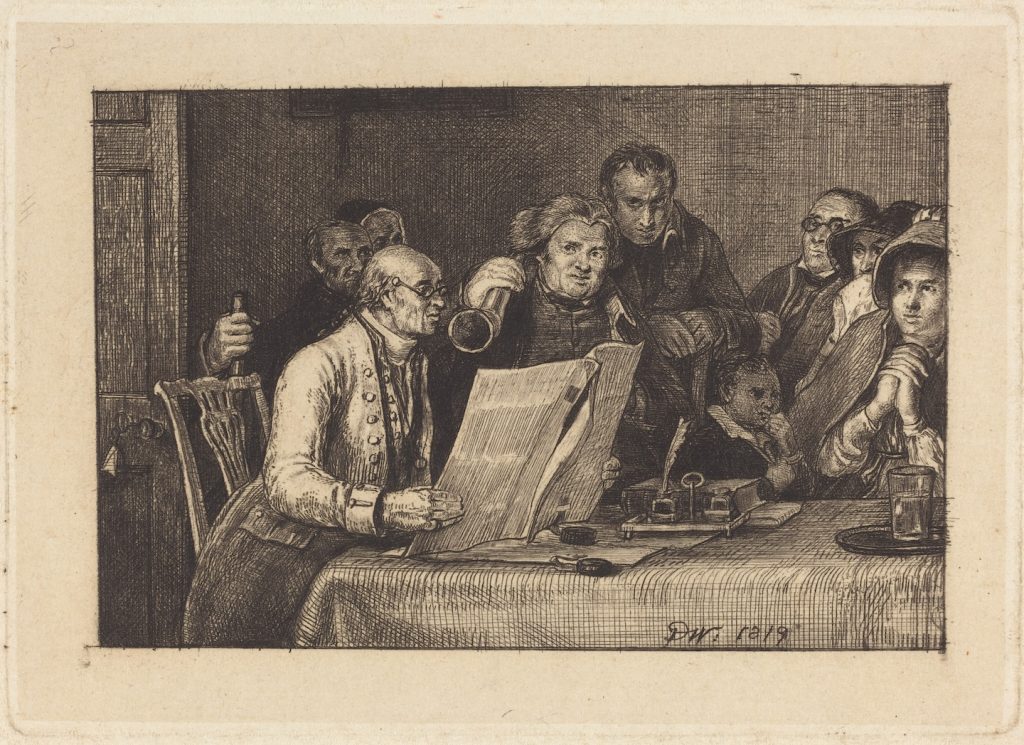
(Photo: Reading the Will, Sir David Wilke, 1819)
During the big recession (2011 ’ish), my business dried up so I took a job with the City Communications Department. One of my jobs was to write and publish articles on the Mayor’s blog. But mostly those of us in the department facilitated communications through public meetings, social media, interactions with the press, etc.
I remember one day rushing into my manager’s office, dismayed and frustrated at the reporting we saw after an event where the Mayor spoke. We were IN that meeting and the way it was reported in no way resembled what actually occurred.
This wasn’t just a “one off” — it happened numerous times after a variety of events and incidents.
The way the truth was twisted was appalling. And yes, I’m naive. I expected better.
The Impact of Our Words
So, over the years, I’ve become more of a skeptic, reading between the lines of what’s reported, questioning sweeping generalizations thrown about. Nonstop.
What do we do about it?
We now tune it out, unsubscribe, change the channel. Look for media we can rely on.
And the word spreads.
“Read this guy’s newsletter — he’s direct and tells the truth.”
Mouthpieces Who Do Themselves No Favors
But for some it’s more than spin.
In recent days we’ve seen some of the worst. Those with a keyboard or microphone have shouted derogatory terms until the words have lost meaning.
They’ve lost all credibility.
They’ve become irrelevant.
What We Expect From Our Leaders
We. Expect. Professionalism. Self-restraint. Respect.
And we expect the same from those who serve beside us in our communities — those who own businesses, teach our children, provide health services, minister, care for our elderly. The list goes on.
Our youth deserve role models…leaders…who help them aspire to higher levels of conduct.
Yes, these people have the right to speak their minds, but they also bear a responsibility to others. And they will bear the burden of how their words and actions echo through hearts and minds.
In closing, I want to share what Jason A. Clark recently wrote after the assassination of Charlie Kirk:
“But it’s time to be honest about what that freedom actually means. The right to say almost anything is not the same as a right to be shielded from the fallout. Speech is powerful, and when people publicly celebrate the murder of another human being, they aren’t just voicing an opinion—they’re revealing something about their own character and moral compass.”